When the Formulation Is Fixed, Why Does Foam Quality Still Change?
In many flexible polyurethane foam production lines, the first response to quality loss is to check the formulation. If the foam becomes too hard, if the surface quality is poor, if density changes between batches, or if the part loses dimensional stability after demolding, attention usually moves toward polyol, isocyanate, or additives. That view is not wrong, but it is incomplete. In industrial production, formulation is only the starting point; real product quality is created when materials meet temperature, pressure, mold conditions, humidity, injection time, and demolding conditions.
This article explains exactly that point: why process control in flexible polyurethane foam is as important as material selection, and how several apparently separate parameters can jointly build or destroy final quality. The goal is not to sell a product; it is to build a diagnostic path so production managers, R&D managers, and quality-control teams can review the real process window before changing the formulation.
1. Formulation Matters, but the Process Determines How the Formulation Behaves
A flexible polyurethane foam system may look perfectly suitable on a datasheet, but behave differently on the production line. Final foam properties do not come only from the raw-material ratio; they are shaped by mixing quality, material temperature, mold temperature, injection time, humidity, mold ventilation, and demolding time.

Several reactions occur at the same time during flexible foam molding: polyurethane network formation, gas generation for cell formation, viscosity increase, gelation, and dimensional stabilization. If one of these stages moves out of its natural rhythm, the product may look acceptable but show weaker performance in compression, resilience, tear strength, or durability testing.
- Point 1: The same density does not always mean the same performance, because cell structure and process history also influence foam behavior.
- Point 2: Increasing material consumption or changing the index is not always the solution; sometimes mold temperature, mixing, or demolding time has simply moved outside the stable window.
- Point 3: In industrial decisions, repeatable quality must be measured, not only one successful laboratory sample.
2. Key Parameters That Change Flexible Foam Quality
To control flexible foam quality, several variables must be viewed at the same time. Each variable matters on its own, but the real value of analysis appears when their combined effects are reviewed.

2.1 Isocyanate Index: Balancing Softness, Hardness, and Polymer Network
The isocyanate index shows the functional ratio between NCO and OH groups. In flexible foam, increasing this ratio can make the foam harder and the network denser. However, if this is done without considering the application and process conditions, resilience or final touch may change. Too low an index can limit strength and durability. For this reason, the index must be evaluated alongside material temperature, reaction time, and part design.
2.2 Mold Temperature: Where Surface Appearance and Skin Formation Are Controlled
Mold temperature is not just a control number; it affects heat transfer, surface quality, skin formation, demolding time, and dimensional stability. A cold mold can cause weak surface quality or incomplete curing, while an overheated mold can accelerate the reaction too much or create a harder surface.
2.3 Polyol and Isocyanate Temperature: Viscosity and Reaction Uniformity
If raw materials are too cold, viscosity increases and mixing becomes more difficult. If they are too warm, the reaction can start earlier than the controllable range. Stable material temperature helps keep rise time, cell structure, and final density more predictable.
2.4 Mixing Pressure and Mix Quality: Where Many Hidden Defects Begin
Poor mixing can create streaks, voids, density differences, irregular cell structure, and localized weakness. In many lines, the issue is not the formulation; it is a dirty mix head, unstable pressure, inconsistent injection ratio, or weak equipment maintenance.
3. Why Parameter Interaction Matters More Than Checking Variables Separately
In real production, no parameter works in isolation. The effect of humidity depends on temperature, mold temperature depends on demolding time, and shot size depends on mixing quality and mold venting.

For example, higher humidity can change the amount of CO2 generated and push the cell structure out of its stable range. The severity of this effect can increase at higher temperature or in a mold with poor venting. Similarly, an incorrect shot may create only a small weight difference, but when poor mixing and early demolding happen at the same time, that small difference can become a serious defect.
- Humidity + High Temperature
- Higher risk of side reactions, unstable cell structure, lower mechanical properties, and poor surface quality.
- Low Mold Temperature + Early Demolding
- Higher probability of tackiness, deformation after demolding, and dimensional instability.
- Poor Mixing + Poor Calibration
- Higher density variation, hardness differences between parts, and increased scrap rate.
4. Control and Prevention Path: From Data Recording to Process Correction
Flexible polyurethane foam control cannot be achieved with general recommendations alone. Each production line needs a practical path: data recording, pattern diagnosis, limited testing, and controlled correction.

- Step 1: Record the real line condition: Track material temperature, mold temperature, RH, mixing pressure, injection time, shot weight, demolding time, and scrap rate across several shifts.
- Step 2: Compare data with the observed defect: Identify the conditions under which the defect repeats. Does it occur only in one shift? Does it correlate with temperature or humidity changes?
- Step 3: Correct one parameter at a time: If several things are changed simultaneously, the real cause will not be clear. Adjustments must be staged and traceable.
- Step 4: Stabilize the process window: The goal is not to produce one good part; the goal is for the line to repeat the same quality consistently.
5. Simulating the Effect of Humidity on Polyurethane Foam Quality
Observe Process Behavior Before Trial and Error
Humidity is one of the variables that can significantly change final polyurethane foam quality without any change in formulation. In real production, however, isolating the exact contribution of humidity from other factors is not always simple.
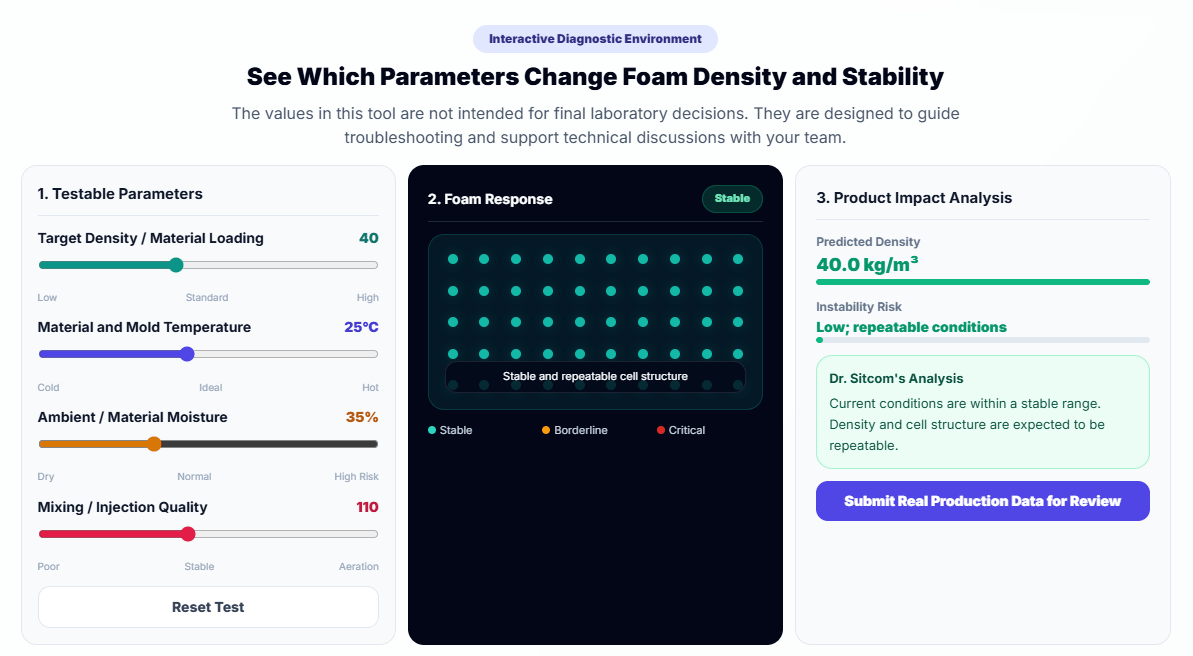
The process simulator helps you interactively evaluate the impact of humidity, temperature, and production conditions, and better understand the relationship between process parameters and final foam quality.
 Click to enlarge
- Change the ambient humidity level and observe how foam cell structure and collapse probability change.
- Adjust material and mold temperature and review the effect on process stability, surface quality, and demolding time.
- Change mixing quality and see how it relates to voids, streaks, and density fluctuation.
- Change several parameters at the same time to see why production problems are usually not caused by one factor alone.
6. Where Should You Go After This Article?
If you have read this far, you are probably facing one of these challenges: quality fluctuation, poor surface quality, density variation, uncertain demolding time, repeated scrap, or different performance between similar parts. The next step should be practical and measurable.
- For numerical review, enter the flexible foam process-stability simulator and test your line scenario.
- For deeper analysis, prepare data on material temperature, mold temperature, humidity, mixing pressure, shot weight, and demolding time.
- For an actionable decision, submit a short technical brief so the Sepehr Donya team can review the troubleshooting path based on actual line conditions.
Submit a Polyurethane Technical Brief for Initial Analysis